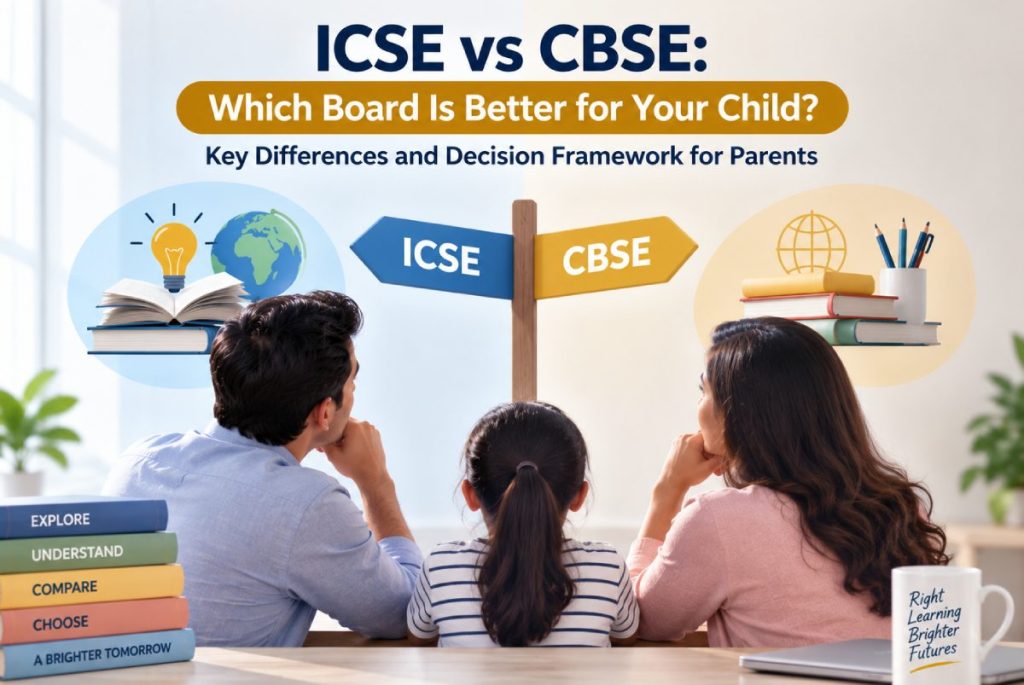
If you are choosing a school for your child, you have probably encountered the same question repeatedly:
ICSE vs CBSE which is better?
It is one of the most common questions parents ask when comparing schools.
But there is an important problem with the question. There is no universally “better” board for every child.
ICSE and CBSE have different curriculum structures, subject frameworks, assessment approaches, and educational emphases. The better choice depends on the child’s learning preferences, future plans, family circumstances and, importantly, the quality of the school implementing the curriculum.
This distinction matters when comparing schools in Kalyan, Kalyan West, and surrounding areas because parents may find strong ICSE and CBSE options within the same geographic region.
Instead of asking only:
“Which board is better?”
a more useful question is:
“Which board and school combination is the better fit for my child?”
This guide compares ICSE vs CBSE, explains the practical differences parents should understand, addresses the question of ICSE vs CBSE for the future, and provides a framework you can use before selecting a school.
Quick Answer: ICSE vs CBSE Which Is Better?
Neither ICSE nor CBSE is universally better. Both are established Indian school education systems, but they differ in curriculum structure, subject choices, assessment, and implementation.
In broad terms:
- ICSE may appeal to parents looking for a broad curriculum, strong language development, detailed subject coverage, and meaningful project/internal-assessment components.
- CBSE may appeal to parents looking for a widely used national curriculum, structured progression, and a school system that aligns closely with the broader NCERT/CBSE ecosystem and many national competitive-exam pathways.
- The school itself matters enormously. Teaching quality, teachers, student support, classroom environment, facilities, school culture and extracurricular opportunities can have a greater day-to-day impact than the board name alone.
CISCE’s current materials describe project work as an integral part of ICSE-level subjects and include skill-based subject options. CBSE’s current academic framework includes structured curriculum and assessment guidance and is also expanding areas such as computational thinking, artificial intelligence, and skill education.
So the short answer is:
Choose the board that fits your child’s learning needs and future plans, then choose the strongest school you can realistically access within that board.
ICSE vs CBSE: At a Glance
| Factor | ICSE | CBSE |
| Curriculum approach | Broad and detailed subject coverage with scope for project and internal assessment | Structured national curriculum framework with prescribed schemes of study and ongoing curriculum updates |
| Subject breadth | Broad subject basket, particularly visible at ICSE secondary level | Broad subject options, with structured subject schemes and electives depending on stage |
| Languages | Strong emphasis on English and language proficiency; second-language requirements apply at ICSE | Multiple-language framework with current language scheme updates |
| Assessment | Board examination plus internal/project components in applicable subjects | Board examinations plus school-based/internal assessment components depending on class and subject |
| Learning style | Can suit students who enjoy detailed content, languages, and project/application work | Can suit students who prefer a structured national curriculum and systematic progression |
| Competitive exams | Students can prepare successfully, but may need to align school learning with specific competitive-exam requirements | Often considered convenient for students targeting national entrance-exam pathways because of curriculum alignment |
| Practical learning | Project work and internal assessment are significant features at ICSE level | Practical, experiential and skill-based learning are also incorporated within the current CBSE framework |
| Transferability | Widely recognised across India; school-specific transfer policies still matter | Widely adopted across India and particularly common among schools serving mobile families |
| Suitable for | Students who value broad academic exposure, languages and detailed learning | Students who value structured progression, national curriculum continuity and flexibility across locations |
| Best choice? | Depends on child and school | Depends on child and school |
This table is a starting point, not a verdict. The actual experience can differ significantly between two schools following the same board.
What Is the Difference Between ICSE and CBSE?
The simplest way to understand the difference is to look at how each curriculum is structured and how the school implements it. ICSE refers to the Indian Certificate of Secondary Education examination, conducted by the Council for the Indian School Certificate Examinations (CISCE).
CBSE refers to the Central Board of Secondary Education, which provides curriculum, academic guidelines, schemes of study, and assessment frameworks for affiliated schools. Both systems have evolved over time.
Therefore, parents should be careful about relying on old comparisons such as:
“ICSE is only about rote learning.”
or:
“CBSE is only about competitive exams.”
Those descriptions are too simplistic. Both boards have incorporated elements of conceptual, practical, skill-based, and experiential learning.
1. ICSE vs CBSE Curriculum Approach
Curriculum structure is one of the most important differences to understand.
ICSE
CISCE describes its curriculum as holistic and says affiliated schools have scope to develop their own educational niche while working within the board’s framework.
At the ICSE level, project work/internal assessment is an integral part of subjects, while students also have a basket of subjects from which choices can be made.
This can make ICSE particularly attractive to parents who value:
- broad academic exposure
- language development
- detailed subject coverage
- projects
- application of concepts
- varied subject choices
CBSE
CBSE provides a structured curriculum and scheme of studies for affiliated schools. Its current academic framework is also evolving. For example, CBSE currently provides a curriculum framework for Computational Thinking and Artificial Intelligence for Classes III–VIII, alongside skill education and other enrichment initiatives.
This means the common perception that CBSE is purely textbook-driven does not accurately describe the current curriculum direction.
What should parents compare?
Instead of asking which curriculum looks better on paper, ask:
How does the school turn the board curriculum into an everyday learning experience?
That is where schools can differ substantially.
2. ICSE vs CBSE Subject Breadth
Subject breadth matters because it affects what children study and how much academic exposure they receive.
At the ICSE secondary level, students generally study a combination of compulsory subjects and choose additional subjects from prescribed groups.
The current ICSE regulations specify a minimum six-subject structure, including English, a second language, History/Civics/Geography, and additional subjects from prescribed groups.
ICSE subject options can include areas such as:
- Mathematics
- Science
- Economics
- Commercial Studies
- Modern Foreign Languages
- Computer Applications
- Art
- Performing Arts
- Physical Education
- Yoga
- Environmental Applications
- Robotics and Artificial Intelligence
- Other skill-oriented subjects
The exact choices depend on the school and the applicable year’s regulations. CBSE also provides structured subject choices, electives, and skill-based subjects depending on the student’s stage.
The important difference for parents is therefore not simply “more subjects versus fewer subjects.”
It is:
Which subject combination and learning structure best suits my child?
3. ICSE vs CBSE Languages
Language education is an important consideration, particularly in the primary and middle-school years. ICSE has traditionally placed significant emphasis on English language development, and its curriculum framework also discusses language proficiency, communication, and creative writing.
The current ICSE examination structure includes English and a second-language requirement at the secondary examination level. CBSE also has a structured language framework and has issued updated guidance around its language scheme for the 2026–27 session.
Parents should ask:
- Which languages are taught?
- From which grade?
- How much reading is encouraged?
- How much writing practice is provided?
- Do students speak and present regularly?
- How are communication skills developed?
- Is the second language appropriate for the child?
For a child who enjoys reading, writing, communication, and languages, the school’s actual language programme may be more important than the board label.
4. ICSE vs CBSE Assessment
Assessment is another area where parents often hear conflicting information. ICSE includes internal/project assessment as an integral part of the examination structure.
The current ICSE regulations specify different weightages depending on the subject. For example, Mathematics and Science have an 80% external and 20% internal component, while several Group III subjects have a 50% external and 50% internal structure.
CBSE also uses a combination of board examinations and internal/school-based assessment depending on the class and subject. The current CBSE academic system includes curriculum, assessment, and competency-oriented resources, alongside newer skill and learning frameworks.
What does this mean for parents?
Do not reduce the comparison to:
“ICSE has projects and CBSE has exams.”
That is an outdated oversimplification.
Instead ask:
- How often are students assessed?
- What types of assessments are used?
- How much project work is involved?
- How is feedback provided?
- Are assessments used to identify learning gaps?
- How much pressure does the school place on testing?
5. ICSE vs CBSE Learning Style
This is one of the most important factors for your child’s day-to-day experience.
Some children learn well when they:
- read extensively
- write detailed answers
- explore subjects deeply
- work on projects
- connect different areas of knowledge
Other children may thrive in a more structured environment with:
- clear academic progression
- systematic practice
- regular assessments
- structured textbooks
- predictable learning objectives
- Neither learning style is inherently superior.
The question is:
Which approach works better for my child?
- And remember that the school makes a major difference.
- A strong CBSE school can provide highly engaging experiential learning.
- A strong ICSE school can also provide structured, disciplined academic preparation.
- The board does not operate independently of the school.
6. ICSE vs CBSE for Competitive Exams
This is one of the most searched questions around the comparison.
Parents often ask:
“Which is better for NEET, JEE, or other competitive exams: ICSE or CBSE?”
There is no simple board-only answer. CBSE is often viewed as convenient for students preparing for national entrance examinations because of the relationship between its school curriculum and the broader NCERT ecosystem used extensively in national-level academic preparation.
However, students from ICSE backgrounds can also successfully prepare for competitive examinations.
At the senior-secondary stage, what matters increasingly includes:
- subject selection
- conceptual understanding
- preparation resources
- coaching strategy
- practice
- time management
- quality of teaching
Therefore, choosing a school board solely because you think it guarantees success in a competitive examination is not a sound decision. For a child who is still in Nursery, primary, or middle school, future competitive-exam planning should generally not override the need for a healthy and appropriate foundational education.
7. CBSE or ICSE Which is Better for Future?
The query “CBSE or ICSE which is better for future?” is understandable, but “future” can mean several different things.
It might mean:
- higher education in India
- engineering
- medicine
- commerce
- humanities
- studying abroad
- moving between cities
- competitive examinations
- career flexibility
There is no single board that guarantees a better future.
If your child may move cities frequently
CBSE’s widespread presence across India can be a practical advantage for families who anticipate relocating. But this should be evaluated alongside the quality of the receiving school.
If your child enjoys languages and broad subject exposure
An ICSE school may be attractive because of its curriculum structure and language emphasis.
If your child is likely to target national competitive examinations
CBSE may be a practical option, particularly at the secondary/senior-secondary stage. But school quality, teaching, and preparation strategy remain crucial.
If your family is considering international education
Do not assume that one Indian board automatically provides a superior pathway. Check the admission requirements of the universities or school systems you are actually considering.
8. ICSE vs CBSE: Practical Learning
Another common misconception is that only one board supports practical learning. That is not accurate. CISCE explicitly highlights project work and activity-based learning as part of its curriculum approach.
CBSE also incorporates experiential, skill-based, and technology-oriented learning into its current academic initiatives. Its current framework includes computational thinking and AI for Classes III–VIII, while skill education is being implemented across specified grades.
Therefore, parents should evaluate how a specific school implements practical learning.
Ask:
- How often do students conduct experiments?
- Are projects individual or collaborative?
- Are students encouraged to solve real problems?
- How is technology used?
- Are students expected to create, investigate, and present?
- Do children learn outside the textbook?
This gives you a much more accurate picture than the board name alone.
9. ICSE vs CBSE: Technology, AI and STEM
Technology is increasingly relevant to school selection.
But parents should be careful not to confuse:
“The school has an AI lab.”
with:
“Students meaningfully learn computational thinking and technology.”
The current CBSE ecosystem includes a curriculum framework for computational thinking and artificial intelligence for Classes III–VIII.
CISCE’s current ICSE regulations also include Robotics and Artificial Intelligence among the listed Group III subject options. This demonstrates that technology and AI are no longer exclusive to one board.
Ask the school:
- Which grades receive STEM education?
- Is coding taught?
- Are students exposed to robotics?
- How are AI concepts introduced?
- Are activities hands-on?
- Is technology integrated into normal subjects?
- How is screen time balanced with practical activities?
10. ICSE vs CBSE: Sports and Extracurricular Activities
Sports are not determined by the board. A CBSE school can have exceptional sports facilities. An ICSE school can have exceptional sports facilities. The deciding factor is the school’s investment, timetable, and culture.
Parents should compare:
- number of sports
- coaching
- training frequency
- competition opportunities
- indoor/outdoor facilities
- participation across age groups
The same applies to:
- music
- art
- theatre
- dance
- clubs
- leadership activities
- competitions
Ask:
“How much time does a typical student actually spend participating in these activities?”
That is more useful than asking how many activities appear on the school website.
11. ICSE vs CBSE: Transferability
For families who relocate frequently, transferability can be an important practical consideration. CBSE schools are widespread across India, which can make finding another CBSE school easier in many cities. ICSE schools are also found across India, but availability varies more by locality.
However, changing schools can involve differences in:
- subject sequence
- textbooks
- languages
- academic calendars
- admission policies
- grade-level expectations
So parents should consider the likelihood of relocation before making the decision.
If you expect to move every few years, ask:
“How easy will it be for my child to transition into another school?”
12. ICSE vs CBSE vs State Board
Some parents should not limit the comparison to ICSE versus CBSE. In Maharashtra, the State Board is another relevant option.
The right comparison may therefore be:
ICSE vs CBSE vs State Board
rather than simply ICSE vs CBSE.
| Factor | ICSE | CBSE | Maharashtra State Board |
| Curriculum | Broad and detailed | Structured national curriculum | Maharashtra-focused state curriculum |
| Language emphasis | Strong | Structured multilingual approach | Depends on school and programme |
| National mobility | Good | Very strong | Strong within Maharashtra; varies outside |
| Practical learning | Project/internal assessment features | Experiential and skill-based initiatives | Varies by school and programme |
| Competitive-exam pathway | Possible | Often considered convenient for national exams | Possible |
| School availability | Moderate | Very widespread | Very widespread in Maharashtra |
| Best suited to | Depends on child | Depends on child | Depends on child/family |
| Key consideration | Curriculum depth and school quality | Structure, mobility and school quality | Local continuity and school quality |
Again, the table should not be interpreted as a ranking. A high-quality State Board school may be a better choice for a particular child than a poorly fitting ICSE or CBSE school.
13. What Matters More: Board or School?
This may be the most important point in the entire article. Imagine two schools.
School A
- preferred board
- weak classroom interaction
- limited student support
- long commute
- little extracurricular participation
School B
- acceptable board
- excellent teachers
- strong classroom engagement
- supportive environment
- manageable commute
- good sports and activities
For many children, School B could provide a stronger overall educational experience. That is why parents should avoid treating the board as the only selection criterion. The board provides the framework.
The school creates the day-to-day experience.
14. What Should Parents Look for When Choosing an ICSE or CBSE School?
Once you have selected the board, compare schools using these factors.
Teaching quality
Ask:
- Who teaches my child’s grade?
- How experienced are teachers?
- What is the class size?
- How does the school support different learning levels?
Curriculum implementation
Ask:
- How closely does classroom teaching follow the board curriculum?
- How much application-based learning is used?
- How are assessments conducted?
Student support
Check:
- academic support
- counselling
- wellbeing
- teacher accessibility
- parent communication
Infrastructure
Look at:
- classrooms
- library
- laboratories
- computer/ICT facilities
- sports facilities
- art/music spaces
- medical facilities
Extracurricular activities
Compare:
- sports
- music
- art
- clubs
- competitions
- leadership programmes
Safety
Ask about:
- campus security
- transport
- emergency procedures
- student supervision
- bullying prevention
Location
Calculate the actual daily commute.
Cost
Compare the complete annual cost rather than tuition alone.
15. ICSE vs CBSE Board: Questions Parents Should Ask During a School Visit
Take these questions with you.
About academics
- How does the school implement the board curriculum?
- What is the typical class size?
- How are learning gaps identified?
- What academic support is available?
- How frequently are assessments conducted?
About teaching
- How much project-based learning is included?
- How much practical work do students do?
- Are students encouraged to ask questions?
- How does the school support different learning styles?
About languages
- Which languages are taught?
- How are reading and communication skills developed?
- How much writing practice is provided?
About science and mathematics
- How often do students use laboratories?
- How is problem-solving taught?
- How are practical concepts connected to classroom learning?
About technology
- How is technology used in learning?
- Are coding, AI, STEM or robotics activities available?
- Which grades participate?
About student development
- What sports are available?
- What arts and cultural activities are offered?
- Are clubs and competitions available?
About wellbeing
- What support is available for students who struggle academically?
- How does the school address behavioural concerns?
- What wellbeing or counselling support is available?
About admissions
- What are the age criteria?
- What documents are required?
- Is there an assessment or interaction?
- What are the admission dates?
- What is the complete fee structure?
16. Which Board Is Better for Primary School?
For younger children, parents should be particularly careful about over-focusing on the eventual Class 10 or Class 12 examination.
For Nursery, kindergarten, and primary-school children, the more immediate questions are:
- Is my child happy at school?
- Are teachers approachable?
- Is learning age-appropriate?
- Is the child developing language skills?
- Are mathematics concepts understood?
- Does the child get enough physical activity?
- Is there time for creative activities?
- Is the environment supportive?
- Does the child feel safe?
A strong foundation is more important than choosing a board because of a hypothetical career path ten years later.
17. Which Board Is Better for a Child Who Enjoys Languages?
If your child naturally enjoys:
- reading
- writing
- storytelling
- communication
- literature
- languages
you may want to examine ICSE schools closely because of the curriculum’s strong language component. But do not stop there. Compare the school’s actual language programme.
Ask to see:
- reading resources
- library
- writing activities
- student presentations
- language competitions
- classroom work
A school’s implementation matters more than assumptions about the board.
18. Which Board Is Better for a Child Interested in Science and Mathematics?
Both ICSE and CBSE can provide strong foundations in mathematics and science.
The important factors are:
- conceptual teaching
- laboratory exposure
- problem-solving
- practical work
- teacher quality
- assessment
- academic support
Parents should visit the school and ask how often students actually conduct experiments and work on applications. Do not choose solely because one board is described as “better for science.”
19. Which Board Is Better for Studying Abroad?
Neither board automatically guarantees admission to an international university. Universities evaluate students based on their academic qualifications and broader application requirements.
Depending on the country and university, these may include:
- school results
- subject choices
- entrance requirements
- standardised tests where applicable
- English proficiency
- extracurricular achievements
- essays/personal statements
- recommendations
If studying abroad is a serious future possibility, parents should research the specific countries and universities they may target rather than selecting a board based on generic claims.
20. ICSE vs CBSE Board: A Better Decision Framework
Instead of asking:
ICSE or CBSE board?
Use this five-step process.
Step 1: Understand your child
Ask:
- What does my child enjoy learning?
- How does my child learn best?
- Does my child enjoy reading and writing?
- Does my child prefer structured practice?
- Does my child enjoy projects and activities?
- Does my child need additional support?
Step 2: Understand your family
Consider:
- location
- commute
- budget
- likelihood of relocation
- siblings
- school timings
- transport
Step 3: Think about the future
Consider, without over-planning:
- likely higher education direction
- competitive exams
- possibility of moving cities
- international education
- desired language pathway
Step 4: Shortlist schools
Find schools that:
- follow your preferred board
- offer the required grade
- are realistically accessible
- fit your budget
Step 5: Compare the actual schools
This is where the final decision should happen.
Compare:
Teachers + curriculum implementation + student support + facilities + activities + safety + commute + cost
ICSE vs CBSE Board Decision Matrix for Parents
You can use this simple framework.
| Your Priority | What to Investigate |
| Strong language development | School’s language teaching and reading programme |
| Broad subject exposure | ICSE curriculum and subject implementation |
| National mobility | Availability of schools if relocating |
| Competitive exams | Subject alignment, senior-secondary pathway and preparation |
| Practical learning | Laboratory, project and experiential learning |
| Technology | STEM, coding, AI and robotics programmes |
| Sports | Coaching, facilities and participation |
| Smaller commute | Actual school route and transport |
| Academic support | Remedial and personalised support |
| International plans | Requirements of target countries/universities |
| Budget | Complete annual cost |
| Long-term continuity | Grades offered by the school |
Common Myths About ICSE vs CBSE
Myth 1: ICSE is always harder than CBSE
Difficulty is not a simple measure of board quality. The curriculum structures differ, and students may find one approach more suitable than another.
Myth 2: CBSE is only for competitive exams
CBSE schools provide much more than competitive-exam preparation. Its current curriculum ecosystem includes languages, skills, computational thinking, AI, sports, and other enrichment initiatives.
Myth 3: ICSE guarantees better English
The ICSE framework places significant emphasis on language, but a child’s language development also depends heavily on teachers, reading culture, classroom practice, and the school environment.
Myth 4: ICSE is not suitable for competitive exams
Students from ICSE backgrounds can prepare for competitive examinations. The important factors include conceptual understanding, subject preparation, resources, and practice.
Myth 5: CBSE is automatically easier
A curriculum being perceived as more structured does not mean it is automatically easier for every student.
Myth 6: The board determines the quality of the school
It does not. Teacher quality, leadership, school culture, student support, and implementation can make an enormous difference.
For Parents in Kalyan: How Should You Compare ICSE and CBSE Schools?
Parents in Kalyan and Kalyan West have the advantage of being able to compare schools following different boards within a relatively concentrated area.
Your shortlist may include:
- ICSE schools
- CBSE schools
- IGCSE/international schools
- Maharashtra State Board schools
If you are specifically looking for ICSE schools in Kalyan, compare the curriculum and school environment rather than assuming that every ICSE school provides the same experience.
Likewise, if you are considering CBSE schools in Kalyan, compare the actual implementation of the CBSE curriculum rather than choosing solely because CBSE is widely available.
For families living around Kalyan West, Khadakpada, Umbarde, Adharwadi, Wayle Nagar, or nearby areas, commute should also be part of the decision.
Where Does Gautam Singhania Global School Kalyan Fit Into This Decision?
Gautam Singhania Global School in Kalyan West is an ICSE-affiliated school offering education from Nursery to Grade 7.
For parents considering an ICSE school in Kalyan, the school can be included in a broader comparison of:
- curriculum
- teaching approach
- academic support
- practical learning
- sports
- extracurricular activities
- technology
- innovation
- facilities
- student development
- school environment
- commute
The Kalyan campus currently highlights more than 20 facilities spanning sports, academics, arts, technology, and innovation.
These include areas such as:
- swimming
- cricket
- football
- athletics
- basketball
- badminton
- pickleball
- archery
- skating
- gymnastics
- yoga
- art
- music
- mathematics
- ICT and AI
- innovation
- physics
- chemistry
- biology
- collaborative learning spaces
For parents, however, the useful comparison is not simply the number of facilities.
The better question is:
How do these facilities contribute to the child’s everyday learning and development?
Parents should therefore evaluate the school using the same framework applied to every other school:
Curriculum + teaching + student support + practical learning + activities + facilities + safety + commute + total cost + long-term fit.
That makes the comparison more meaningful and avoids choosing a school simply because of its marketing claims.
ICSE vs CBSE: A Simple Decision Tree
If you are still unsure, use this sequence.
Question 1: Does your family have a strong reason to prefer one board?
If yes, shortlist schools within that board.
If no, continue.
Question 2: Is relocation likely?
If frequent relocation is likely, investigate CBSE availability in your likely destinations.
If not, continue.
Question 3: What learning environment suits your child?
Consider:
- languages
- detailed subject learning
- structured practice
- project work
- practical activities
- academic pace
Question 4: Which schools have the strongest teaching environment?
Compare actual schools rather than board labels.
Question 5: Which school is practical?
Compare:
- commute
- timings
- transport
- fees
- grade continuity
Question 6: Which school would your child enjoy attending?
This final question is easy to overlook.
But it matters.
Frequently Asked Questions About ICSE vs CBSE
ICSE VS CBSE which is better?
Neither is universally better. ICSE may suit students who value broad subject exposure, language development, and project/internal-assessment components, while CBSE may suit families looking for a structured national curriculum and widespread school availability.
The quality of the individual school should be a major part of the decision.
ICSE vs CBSE Which is better for future?
Both can provide strong pathways to higher education. The better choice depends on the child’s academic strengths, future plans, family circumstances, school quality, and likely education pathway. Do not choose a board solely because of predictions about a child’s future career.
Is CBSE better for JEE and NEET?
CBSE is often considered convenient for national competitive-exam preparation because of its close relationship with the broader NCERT curriculum ecosystem. However, students from other boards can also prepare successfully. Preparation quality, conceptual understanding, subject choices, and consistent practice remain important.
Is ICSE better for English?
ICSE places substantial emphasis on language development, particularly English, but actual English proficiency depends heavily on the school’s teaching, reading culture, and opportunities for communication.
Is ICSE harder than CBSE?
There is no simple objective answer. The two systems differ in curriculum structure, subject requirements, and assessment. A curriculum that feels demanding to one student may suit another student very well.
Which is better for primary school: ICSE or CBSE?
For primary-school children, parents should focus heavily on teaching quality, foundational literacy and numeracy, student wellbeing, classroom environment and age-appropriate learning. The board should be considered alongside these factors rather than in isolation.
Which board is better for studying abroad?
Neither board automatically guarantees an advantage for international university admission. The requirements depend on the country, university, programme and student’s overall academic profile.
Is ICSE accepted across India?
Yes. ICSE is a recognised Indian school-leaving examination system. However, parents transferring schools should still check the receiving school’s grade, subject, and admission requirements.
Is CBSE more widely available than ICSE?
CBSE has a very large network of affiliated schools across India, which can be a practical advantage for families who move between cities. ICSE schools are also available across India, but availability varies by location.
Should I choose ICSE or CBSE based on my child’s career?
Not at a very young age. If your child is in Nursery, kindergarten, or primary school, focus first on building strong foundations in language, mathematics, curiosity, confidence, and learning habits.
As the child progresses, subject choices and future academic plans can become more specific.
What should I compare besides the board?
Compare:
- teachers
- class size
- curriculum implementation
- academic support
- language development
- science laboratories
- mathematics teaching
- technology
- sports
- extracurricular activities
- safety
- student wellbeing
- commute
- fees
- future grade continuity
Final ICSE vs CBSE Checklist for Parents
Before making your decision, ask:
About the child
- What type of learner is my child?
- What subjects does my child enjoy?
- Does my child need additional academic support?
- Does my child enjoy projects, reading, practical activities, or structured practice?
About the family
- Are we likely to relocate?
- What commute can our child comfortably manage?
- What is our realistic annual school budget?
- Do siblings need to attend the same school?
About the future
- Do we have a specific higher-education direction?
- Are national competitive exams likely to matter later?
- Could international education become an option?
- Do we need a school with long-term grade continuity?
About the school
- Is the board affiliation verified?
- Does the school offer my child’s required grade?
- How strong are the teachers?
- How does the school implement the curriculum?
- What academic support is available?
- How much practical learning takes place?
- What sports and activities are offered?
- How does the school support wellbeing?
- Is the commute practical?
- What is the complete cost?
Final Verdict: ICSE or CBSE?
If you came to this article looking for a one-word answer, the honest answer is:
It depends.
- ICSE is not automatically better than CBSE.
- CBSE is not automatically better than ICSE.
Both provide established educational pathways, and both have evolved to incorporate broader learning, skills, and practical approaches.
The more important decision is the combination of board + school + teaching + child fit.
- For one child, an excellent ICSE school may be the ideal choice.
- For another, a strong CBSE school may be more appropriate.
- For another family, a good Maharashtra State Board or international-curriculum school may make more sense.
The right decision should therefore follow this order:
Understand your child → understand your family’s circumstances → identify future priorities → shortlist suitable boards → compare actual schools → visit campuses → compare total cost → make the decision.
If you are comparing schools in Kalyan, do not stop at the search phrase “ICSE vs CBSE.”
Go one step further.
Ask:
Which school provides the learning environment, support, curriculum, opportunities, and daily experience that are right for my child?
That is a much better question, and a much better way to choose a school.
For parents considering an ICSE school in Kalyan West, Gautam Singhania Global School Kalyan is one option that can be evaluated within this broader framework. The school currently offers ICSE education from Nursery to Grade 7.
Ultimately, the strongest school choice is not the one with the strongest marketing claim.
It is the one that fits your child, your family, and your long-term educational goals.