
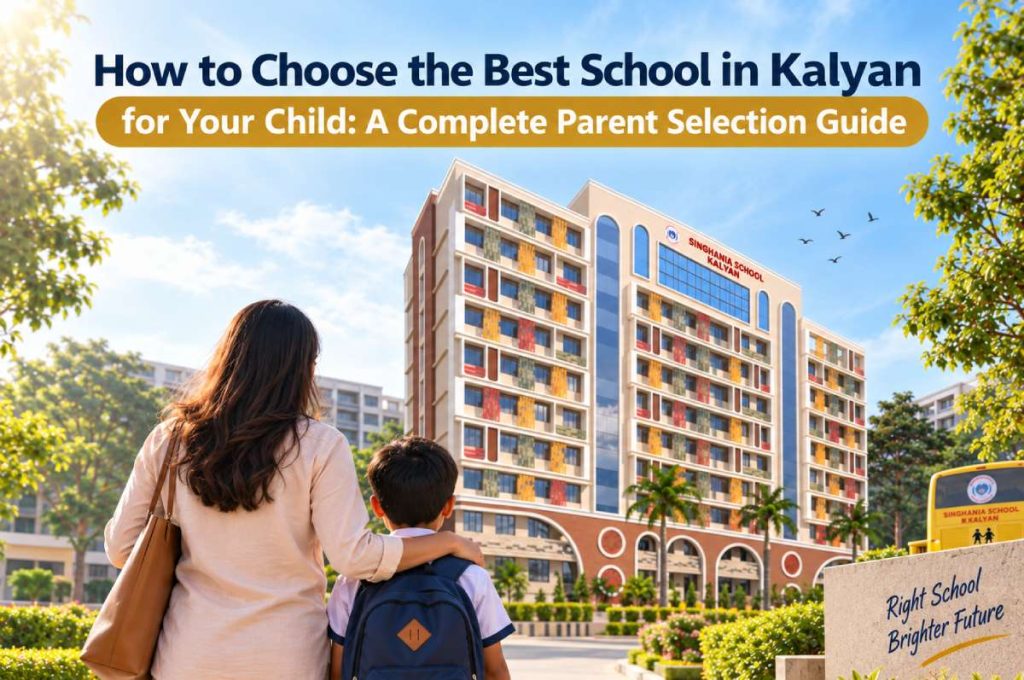
Choosing a school is one of the most important decisions parents make during a child’s early years. With many schools in Kalyan and Kalyan West offering different curricula, facilities, teaching approaches, and extracurricular programmes, deciding where to apply can feel overwhelming.
The best school in Kalyan for your child is not necessarily the school with the biggest campus, the longest list of facilities or the highest position on a ranking list. The right choice depends on how well a school matches your child’s age, learning needs, family priorities, educational goals, and everyday routine.
Parents comparing schools in Kalyan should therefore look beyond advertisements and rankings. Curriculum, teaching methodology, classroom environment, student support, safety, facilities, location, admissions, and the overall learning experience all deserve careful consideration.
This guide explains what parents should evaluate before choosing a school in Kalyan, including a practical checklist you can use during your school-selection process.
Quick Answer: How Should Parents Choose a School in Kalyan?
When comparing the best schools in Kalyan, parents should evaluate at least these factors:
- Curriculum and board
- Child’s age and educational stage
- Teaching methodology
- Classroom environment
- Academic and non-academic development
- Sports and extracurricular opportunities
- Science, technology and innovation facilities
- Student wellbeing and support
- Safety and school policies
- Location and daily commute
- Admission requirements
- Fees and additional costs
- Parent-school communication
- Campus environment
- Whether the school’s educational philosophy matches your child
Rather than asking only, “Which is the best school in Kalyan?”, ask:
“Which school is the best fit for my child and my family’s priorities?”
That shift can make the school-selection process much more meaningful.
Why Choosing a School in Kalyan Requires More Than Comparing Rankings
Parents often begin their search with terms such as:
- best school in Kalyan
- best schools in Kalyan
- good schools in Kalyan
- top schools in Kalyan West
- schools in Kalyan
Search results and school rankings can be useful for creating an initial shortlist, but they should not be the only basis for a decision.
A ranking may tell you that a school is popular or frequently mentioned. It may not tell you whether the school’s teaching approach is suitable for your child, whether the commute is practical, how students are supported, or whether the available facilities are actually integrated into learning. A better approach is to create a shortlist of schools and compare them using the same criteria.
For example, parents can create a simple comparison table:
| Factor | School A | School B | School C |
| Board/curriculum | ☐ | ☐ | ☐ |
| Grades offered | ☐ | ☐ | ☐ |
| Teaching approach | ☐ | ☐ | ☐ |
| Classrooms | ☐ | ☐ | ☐ |
| Sports | ☐ | ☐ | ☐ |
| Laboratories | ☐ | ☐ | ☐ |
| Technology | ☐ | ☐ | ☐ |
| Student support | ☐ | ☐ | ☐ |
| Safety | ☐ | ☐ | ☐ |
| Location | ☐ | ☐ | ☐ |
| Admission process | ☐ | ☐ | ☐ |
| Fees | ☐ | ☐ | ☐ |
This makes the decision more objective and helps prevent one attractive feature from influencing the entire decision.
Start With Your Child’s Age and Educational Stage
The right school environment can vary significantly depending on the child’s age. A school that works well for a secondary-school student may not necessarily be the ideal environment for a child entering Nursery or Junior KG.
Parents should first identify the educational stage they are looking for:
- Nursery
- Junior KG
- Senior KG
- Primary school
- Middle school
- Grade-specific admission
- Transfer admission
For younger children, parents may place greater importance on:
- classroom environment
- teacher-child interaction
- emotional comfort
- play and activity-based learning
- language development
- physical activity
- independence
- safety
- age-appropriate learning
As children progress into primary and middle school, parents may increasingly evaluate:
- subject depth
- conceptual learning
- laboratories
- technology
- assessment
- academic support
- sports
- arts
- leadership opportunities
- project-based learning
This is why the question should not simply be “Which is the best school?”
It should be:
“Which school provides the right environment for my child’s current stage of development?”
Compare the Curriculum and Board
Curriculum is one of the first factors parents should understand before shortlisting schools. Gautam Singhania Global School, Kalyan is ICSE-affiliated and currently offers education from Nursery to Grade 7. Parents considering an ICSE school should understand what the curriculum means in practice rather than choosing a board simply because it is popular.
When comparing schools, ask:
- Which board is the school affiliated with?
- Which grades currently follow the board?
- What subjects are offered?
- How are languages taught?
- How does the school approach assessment?
- How much emphasis is placed on conceptual understanding?
- How are practical activities incorporated?
- How are technology and projects used?
- How does the school support different learning needs?
The board is important, but the way the school implements its curriculum matters just as much. Two schools following the same board can provide very different classroom experiences.
Parents should therefore evaluate both:
Curriculum + implementation.
Evaluate the Teaching Methodology
A school’s teaching methodology can influence how children understand concepts, participate in class, and develop independent thinking.
Parents should ask whether learning primarily involves memorisation or whether students are also encouraged to:
- ask questions
- investigate problems
- conduct experiments
- work on projects
- collaborate with classmates
- apply concepts to real situations
- communicate ideas
- solve problems
- reflect on their learning
What does good teaching look like?
Good teaching is not simply about completing the syllabus. It should help children understand why something works, not only remember what the answer is. For example, a science lesson can involve memorising a definition, or students can investigate a concept through an experiment and then connect their observations to the underlying principle.
Parents visiting schools should ask:
“Can you give us examples of how students learn concepts through activities or real-world applications?”
The answer can reveal much more about a school’s educational approach than a marketing statement.
Look Beyond Academic Results
Academic performance is important, but it should not be the only measure of school quality.
A child’s school experience also contributes to:
- communication
- confidence
- teamwork
- creativity
- problem-solving
- discipline
- independence
- leadership
- physical development
- social development
A well-rounded school environment should give students opportunities to develop these capabilities alongside academic knowledge.
Parents can therefore ask:
- How are extracurricular activities incorporated?
- Are students encouraged to participate in sports?
- Are arts and music available?
- Are there opportunities for public speaking?
- Do students participate in projects and competitions?
- Are leadership opportunities available?
- How does the school support students who need additional academic help?
The goal is not to ignore academics. It is to understand the complete educational experience.
Check the Classroom Environment
A child spends a significant part of the school day in the classroom, making the learning environment an important consideration.
During a campus visit, parents should observe:
- classroom size and layout
- lighting and ventilation
- seating arrangements
- learning displays
- availability of learning resources
- technology use
- cleanliness
- student interaction
- teacher-student interaction
Ask whether classrooms encourage students to participate or whether learning is primarily one-directional. For younger children, also consider whether the environment feels welcoming, age-appropriate, and comfortable.
A classroom does not need to be filled with technology to be effective. The more important question is:
Does the environment help students learn, participate, and remain engaged?
Evaluate Sports and Extracurricular Activities
Sports and extracurricular activities should not be treated as optional extras that matter only after academics.
They can provide opportunities for children to develop:
- teamwork
- discipline
- communication
- confidence
- resilience
- coordination
- leadership
- decision-making
When comparing schools in Kalyan, ask what activities are actually available and how regularly students participate. At Gautam Singhania Global School, Kalyan, the campus includes facilities and activities covering areas such as swimming, cricket, football, athletics, basketball, badminton, archery, skating, gymnastics and yoga, along with other student-development facilities.
However, parents should look beyond a list of facilities. Ask:
- Which age groups can use the facilities?
- Are activities conducted regularly?
- Are trained coaches available where applicable?
- Are students encouraged to participate in competitions?
- How are activities balanced with academics?
A sports facility becomes educationally valuable when students have meaningful opportunities to use it.
Review Science, Technology and Innovation Facilities
Modern school education increasingly involves practical learning, technology and problem-solving. When visiting a school, parents should look at whether the infrastructure supports these objectives.
Useful facilities may include:
- science laboratories
- mathematics laboratories
- computer or ICT facilities
- innovation spaces
- technology-enabled classrooms
- project areas
- creative spaces
Gautam Singhania Global School, Kalyan currently lists facilities including Physics, Chemistry and Biology laboratories, a Maths Lab, ICT & AI Lab and Innovation Centre. The important question is not simply whether these facilities exist.
Parents should ask:
How are students actually using them?
For example:
- Do students conduct experiments?
- Do they work on projects?
- Is technology used to solve problems?
- Are students encouraged to create rather than simply consume technology?
- Are activities age-appropriate?
This helps parents distinguish between infrastructure that looks impressive and infrastructure that contributes meaningfully to education.
Understand Student Support
Children learn at different speeds and have different strengths. A good school environment should recognise that students are not identical learners.
Parents should understand how the school approaches:
- academic difficulties
- individual learning needs
- emotional wellbeing
- communication challenges
- behavioural concerns
- confidence-building
- transition between grades
Ask:
“What happens when a child struggles with a particular subject?”
and:
“How does the school communicate concerns with parents?”
The answers can reveal how actively the school supports students beyond standard classroom instruction.
Consider School Safety and Wellbeing
Safety should be a fundamental part of the school-selection process.
Parents should understand the school’s approach to:
- campus security
- visitor management
- student supervision
- emergency procedures
- transport safety
- first aid
- health and hygiene
- child protection
- playground safety
During a school visit, observe whether safety appears to be integrated into the campus environment rather than treated only as a statement on the website. Parents should also ask who they can contact if a safety, wellbeing or safeguarding concern arises.
Consider School Location and Daily Travel
Location can have a surprisingly large impact on a child’s school experience.
A school may appear ideal academically, but a very long daily commute can affect:
- sleep
- energy
- study time
- extracurricular participation
- family routine
- overall wellbeing
Parents searching for schools in Kalyan West should therefore consider the actual daily route rather than judging location only by the address. For families considering Gautam Singhania Global School, Kalyan, the campus is located in Umbarde, Kalyan West.
Parents should calculate:
- morning travel time
- afternoon travel time
- transport availability
- traffic during school hours
- pickup/drop-off arrangements
- travel time during extracurricular activities
A practical school commute is particularly important for younger children.
Review Admission Requirements Carefully
Once parents have shortlisted schools, admission requirements become an important practical consideration.
Before applying, check:
- eligibility
- age criteria
- available grades
- admission dates
- registration process
- required documents
- application procedure
- selection process
- interaction or assessment requirements
- payment timelines
Do not rely on old admission information found through third-party websites. Admission rules, dates, fees, and availability can change between academic years. For the most accurate information, parents should always verify the current academic year’s admission information directly with the school.
For the 2026–27 academic year, Gautam Singhania Global School, Kalyan is accepting admission enquiries, while specific fee details and current admission information should be checked against the latest official school communication.
Understand Fees and Additional Costs
School fees are obviously an important consideration for families, but parents should compare the complete cost of education, not only the headline annual fee.
Depending on the school and grade, parents may need to consider:
- registration/application charges
- admission charges
- tuition fees
- annual charges
- transport
- uniforms
- books
- activities
- extracurricular programmes
- excursions
- technology-related costs
- other school-specific expenses
Before making a decision, ask the school for a clear breakdown of applicable charges for the relevant academic year. This allows families to compare schools more accurately.
Visit the Campus Before Making a Final Decision
A website can help you create a shortlist, but a campus visit provides information that search results cannot.
During the visit, observe:
The people
How do staff members interact with students and parents?
The classrooms
Do they appear active, organised, and age-appropriate?
The students
Do students appear engaged and comfortable?
The facilities
Are facilities maintained and actually accessible to students?
The environment
Does the overall atmosphere match what you want for your child?
Communication
Are your questions answered clearly?
Parents should ideally visit more than one school before making a final decision.
Questions Parents Should Ask During a School Visit
Take a written list of questions with you. Here is a useful school-visit checklist.
Curriculum
- Which board is the school affiliated with?
- Which grades currently follow the curriculum?
- How is the curriculum implemented in the classroom?
Teaching
- What teaching methodology does the school follow?
- How are practical activities incorporated?
- How does the school support different learning needs?
Academics
- How are students assessed?
- How are academic difficulties identified?
- How are parents informed about progress?
Activities
- Which sports are available?
- Which arts and cultural activities are offered?
- Are students involved in competitions?
Technology
- What technology facilities are available?
- How do students use them?
- Are there STEM, AI, or innovation activities?
Student wellbeing
- What student support systems are available?
- How does the school handle behavioural or emotional concerns?
Safety
- What campus security measures are in place?
- How is student pickup/drop-off managed?
- What emergency procedures are followed?
Admissions
- What are the eligibility criteria?
- What documents are required?
- What is the application process?
- What are the important admission dates?
Costs
- What are the total applicable fees?
- Are there additional charges?
- What transport options are available?
Use a School Selection Scorecard
After visiting several schools, it can be difficult to remember what you liked about each one. A simple scorecard can help.
Rate each school from 1 to 5:
|
Selection Factor |
Weight |
Score |
|
Curriculum |
High |
/5 |
|
Teaching methodology |
High |
/5 |
|
Classroom environment |
High |
/5 |
|
Student support |
High |
/5 |
|
Safety |
High |
/5 |
|
Location/commute |
High |
/5 |
|
Sports |
Medium |
/5 |
|
Arts & activities |
Medium |
/5 |
|
Technology/innovation |
Medium |
/5 |
|
Facilities |
Medium |
/5 |
|
Parent communication |
Medium |
/5 |
|
Fees/value |
High |
/5 |
The weighting matters. For example, if daily travel is a major concern for your family, location should receive greater importance than the number of facilities listed on a school’s website.
What Makes a School a Good Fit for Your Child?
There is no universal definition of the best school in Kalyan. A school may be an excellent choice for one child and a less suitable choice for another.
The right fit depends on factors such as:
- child’s age
- personality
- learning style
- academic needs
- interests
- family priorities
- commute
- curriculum preference
- extracurricular interests
- budget
- long-term educational plans
For example, a family may prioritise an ICSE curriculum, while another may prioritise sports infrastructure or proximity to home. This is why parents should use rankings and online reviews as starting points, not final answers.
What Parents Should Look for in an ICSE School in Kalyan
For parents specifically considering an ICSE school, the evaluation should go one step further.
Look at:
- official ICSE affiliation
- grades currently offered
- curriculum implementation
- language learning
- conceptual understanding
- practical learning
- laboratory access
- technology
- extracurricular activities
- academic support
- admission process
- location
Gautam Singhania Global School, Kalyan is an ICSE-affiliated school offering education from Nursery to Grade 7. Parents interested in understanding the curriculum in greater detail should also evaluate how the school translates the ICSE framework into classroom learning, projects, activities, and student development.
Choosing a School Is a Long-Term Decision
A school is more than a place where children attend classes. It becomes part of a child’s daily routine, friendships, learning experiences, and personal development. That is why parents should consider whether the school can provide a consistent environment for the child’s current educational stage and future development. When comparing schools in Kalyan, don’t focus only on one attractive feature.
Instead, consider the complete picture:
Curriculum + teaching + environment + facilities + student support + safety + activities + location + admissions + affordability.
The strongest decision is usually the one made after combining online research with an actual campus visit and direct conversation with the school.
Final School Selection Checklist for Parents
Before making your final decision, ask yourself:
Academic
- Is the curriculum suitable for my child?
- Is the school officially affiliated with the relevant board?
- Does the teaching methodology match what I want?
- How does the school support academic development?
Development
- Are sports available?
- Are arts and cultural activities available?
- Are students encouraged to collaborate and communicate?
- Are technology, STEM, or innovation opportunities available?
Environment
- Did the classrooms feel welcoming and well organised?
- Did students appear engaged?
- Did staff communicate clearly?
- Does the school’s culture align with our family’s expectations?
Safety and support
- Is campus security adequate?
- How are students supervised?
- What support is available when a child faces academic or emotional difficulties?
Practical considerations
- Is the daily commute manageable?
- Is transport available if required?
- Do we understand the admission process?
- Have we checked the latest fee structure?
- Have we confirmed the required documents and dates?
Final decision
- Have we visited the campus?
- Have we compared at least two or three schools?
- Have we considered our child’s individual needs?
- Are we choosing based on overall fit rather than rankings alone?
Frequently Asked Questions
What should I consider when choosing the best school in Kalyan?
Parents should compare curriculum, teaching methodology, classroom environment, student support, safety, sports, extracurricular activities, facilities, location, admissions, and fees. The best school ultimately depends on the individual child’s needs and the family’s priorities.
How do I find good schools in Kalyan?
Start by creating a shortlist of schools based on curriculum, location, and grades offered. Then compare teaching methodology, facilities, student support, safety, activities, admissions, and fees. Visiting shortlisted schools can help parents make a more informed decision.
Which factors are most important when comparing schools in Kalyan West?
Parents should consider curriculum, teaching quality, school environment, student support, safety, facilities, extracurricular opportunities, commute and admission requirements. Location is particularly important because daily travel can affect a child’s routine.
What should I ask during a school campus visit?
Ask about the curriculum, teaching methodology, student assessment, academic support, extracurricular activities, sports, technology, safety, transportation, admissions, and fees. Parents should also observe how students and teachers interact during the visit.
Is the school board the most important factor when choosing a school?
The board is important, but it should not be considered in isolation. Parents should also evaluate how the school implements its curriculum, the quality of teaching, student support, facilities, learning environment, and overall educational approach.
What should parents check before applying for school admission?
Parents should verify the current academic year’s eligibility criteria, age requirements, available grades, admission dates, application process, documents, selection procedure, and applicable fees directly with the school.
Why should parents visit a school before admission?
A campus visit allows parents to observe classrooms, facilities, student interaction, staff communication, campus environment, and safety arrangements. It can provide information that cannot be fully understood from a website or ranking list.
Is Gautam Singhania Global School in Kalyan ICSE-affiliated?
Yes. Gautam Singhania Global School, Kalyan is ICSE-affiliated and currently offers education from Nursery to Grade 7.
Conclusion
Finding the best school in Kalyan should not be about finding a school that simply appears at the top of a search result. It should be about finding an educational environment that fits your child’s age, learning needs, interests, and development while also working for your family’s practical requirements.
When comparing schools in Kalyan and Kalyan West, look at the complete picture: curriculum, teaching methodology, classroom environment, student support, sports, extracurricular activities, technology, facilities, safety, location, admissions, and fees.
Create a shortlist, ask detailed questions, visit the campuses, and compare schools using consistent criteria. For families considering an ICSE school in Kalyan, Gautam Singhania Global School, Kalyan offers an ICSE-affiliated learning environment from Nursery to Grade 7, with an emphasis on academic learning, experiential education, sports, arts, technology, and holistic student development.
Parents can learn more about the school’s curriculum, facilities, and current admission process before deciding whether it is the right fit for their child.